

During the Great Patriotic War, Soviet footballers stood shoulder to shoulder with their countrymen to defend the homeland, while in some places, they still found time to play the beautiful game.
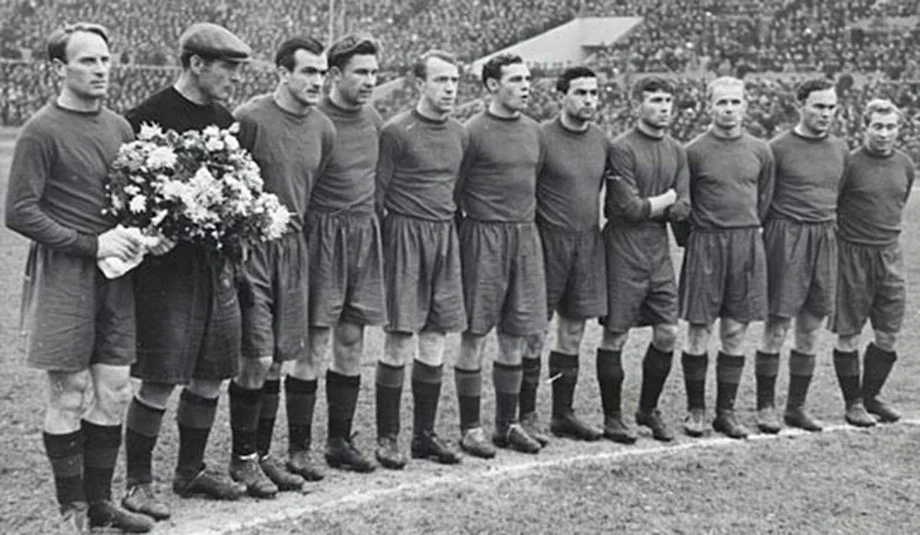
**Footballers on the Front Line**
It’s impossible to cover everything. That phrase comes to mind when you try to compile even a short list of famous footballers who took part in the Great Patriotic War and contributed to victory. The entire nation rose to fight the enemy.
The entire Leningrad Spartak squad voluntarily joined the ranks of the Red Army. Their local rivals from Dynamo also took part in the defense of Leningrad. During the war, CDKA players served in garrison duty – guarding the People’s Commissariat of Defense, the General Staff, and state valuables evacuated from areas occupied by German forces.
In Moscow, many Dynamo players served in the 7th Regiment of the Ministry of Internal Affairs, carrying out patrol duties in the city. Most of the Leningrad Zenit players were evacuated to Kazan along with the optical plant they represented, working 10–12 hours a day at the factory. Moscow Torpedo players labored at their home club’s ZIS automobile plant, which during the war years churned out not only military trucks, tractors, and ambulances, but also certain types of weapons – submachine guns, machine guns, and mines.
One of the best left-backs of the 1930s, Odessa native Mikhail Volin, died just days before the end of hostilities. At the end of 1942 near Stalingrad, Leningrad forward Yevgeny Shelagin – the first player to score five goals in a single match of the Soviet championship – fell in battle.
Before the war, a young man named Yuri Nyrkov had played football but had not yet made it to the senior team level. This future famous defender for CDKA and the USSR national team, at just 17, helped build defensive fortifications near Moscow. He then trained at a tank school and from 1943 served as a commander of a self-propelled artillery unit. After the war ended in Berlin, he played for a unit of the Soviet forces in Germany, where in 1946 he was spotted by Anatoly Tarasov, who had come with CDKA. After finishing his sports career, Nyrkov graduated from the Academy of Armored Forces, rose to the rank of Major General, and served as head of the Personnel Department of the General Staff of the USSR.
In 1943, at 18 years old, Nikolai Nikolayevich Senyukov went to the front – he would later become a defender for Moscow Torpedo. First, he served in foot reconnaissance, hunting for “tongues” (prisoners for interrogation) behind German lines, and then conducted reconnaissance from tanks and armored personnel carriers in the 1st Guards Tank Army. On the Vistula, he was wounded but asked not to be sent to the rear for treatment. He rested for a few days in a field hospital and then returned to battle. Guards Sergeant Major Nikolai Senyukov was awarded the Order of Glory, Third Class, and the Order of the Red Star, as well as the medals “For Courage” and “For Military Merit”.
The legendary goalkeeper of pre-war Leningrad Dynamo, who later became a famous commentator, Viktor Nabutov, served in the border troops and defended his hometown during the blockade – fighting on the tiny bridgehead known as Nevsky Pyatachok. Another Leningrad goalkeeper, who once played for the USSR national team, Georgy Shorets, fought on a second bridgehead – the Oranienbaum one. Running out under fire to help an elderly woman reach a bomb shelter, policeman Pyotr Sychev – the central midfielder for the Leningrad Dynamo first team – was killed on Nevsky Prospekt.
In May 1942, 18-year-old Vladimir Savdunin, a product of the Moscow club Start and future forward for Moscow Dynamo – a participant in the famous white-and-blue tour of Great Britain – volunteered for the front. During the war, he served as a scout in a tank brigade, was awarded the Order of the Red Star and the Order of the Patriotic War, First and Second Class, received three wounds, and after victory played 216 matches for Dynamo, scoring 70 goals. He finished the war in Berlin.
