

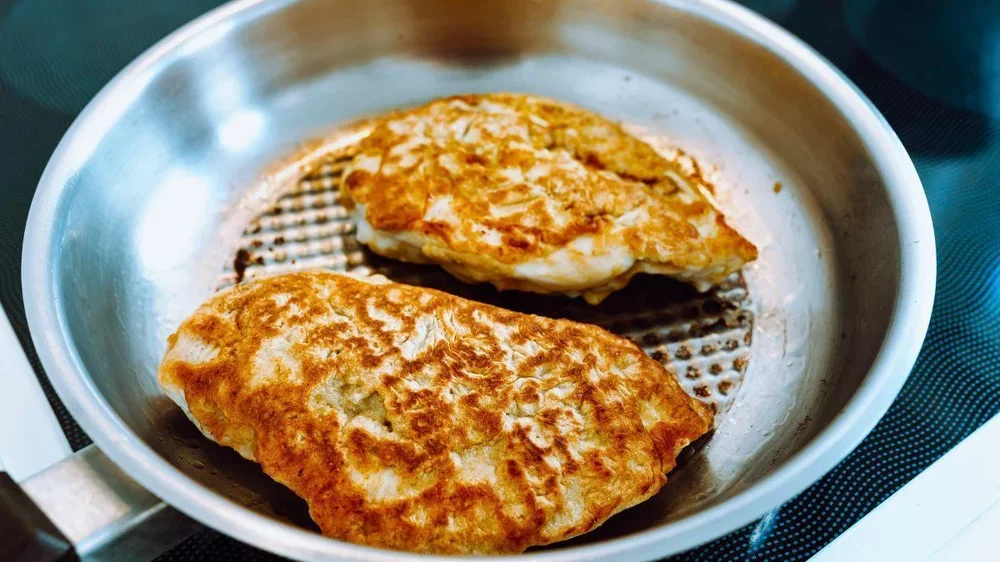
As summer approaches, many people go into a “sprint” to shed a few pounds for the beach—what we call the “bikini operation.” This often leads to unhealthy practices: quick diets, unsupervised by professionals, overly restrictive—which cause the dreaded rebound effect. All lost weight is regained within weeks, sometimes multiplied.
Nutritionist Julia Palacios (@gazpachodepoleo) proposes a radically different approach: stop fighting with food and start understanding it. In *Mucho más que pechuga y lechuga* (Bruguera Tendencias), she dismantles the pillars of diet culture and offers an integrative view that combines science, emotional education, and social context.
**What can your book offer people?**
In this book, I talk about people who have a somewhat complicated relationship with food, to put it gently. There’s a lot of doubt, a lot of guilt, and a constant feeling of not knowing what to eat. My goal is always to reach as many people as possible, knowing that my work, unfortunately, is a luxury because it’s private and not everyone has access. That’s why I’ve gathered what I consider essential to understanding food and nutrition in a chaotic world full of contradictory messages.
**There’s a lot of talk about diet culture. Do you think some people are constantly on a diet without actually learning how to eat?**
Yes, undoubtedly. There are people who have been on a diet their entire lives, especially women, due to aesthetic pressure that mainly falls on us. Also because we tend to ask for more help in this area. There are cases of people who started their first diet at age 8, for example for their first communion, without having any decision-making power. From then on, they chain diets throughout their lives, with phases of heavy restriction and others of abandonment, creating a very complicated relationship with food.
**So what would be ideal?**
The ideal would be to learn how to eat and stop dieting. For me, the first thing is to listen to your body, because it gives us a ton of information that we systematically ignore. It’s also essential to accept body diversity: all bodies are different. Even if two people eat the same, move the same, sleep the same, and have the same stress, they will still be different. That must be accepted.
**What are the most common mistakes people make when they want to diet or eat better?**
Not considering each person’s context. Work hours, cooking skills, purchasing power, or time available to cook are not the same for everyone. If you don’t take that into account, you end up applying rules that don’t fit real life, and that creates a lot of frustration because they can’t be maintained. Another big mistake is eating too little. When we eat, we provide energy and nutrients to the body. If we offer variety and sufficient quantity, the body can choose. But if we always go for the minimum, the body has no margin and settles for what’s there, which can cause more anxiety or lack of satiety.
**It’s often said that “everything tasty makes you fat.” What do you think?**
We have demonized many foods and reduced eating to very simple things like boiled vegetables, grilled meats, or rice. If you have to eat like that three times a day for life, it’s normal to get bored and then eat more when you break out of that because it’s more pleasurable. The key is variety. No food group needs to be eliminated entirely. Bread, rice, potatoes, legumes, vegetables—all can be part of a healthy diet.

**Is the Harvard plate a good reference?**
It has useful things, like proportions, but I would change one thing. The Harvard plate suggests half vegetables, a quarter carbohydrates, and a quarter protein. I think the vegetables should be at least half, but it’s fine to adjust depending on the meal. What’s important is to normalize eating everything without guilt and to learn to listen to your body.