

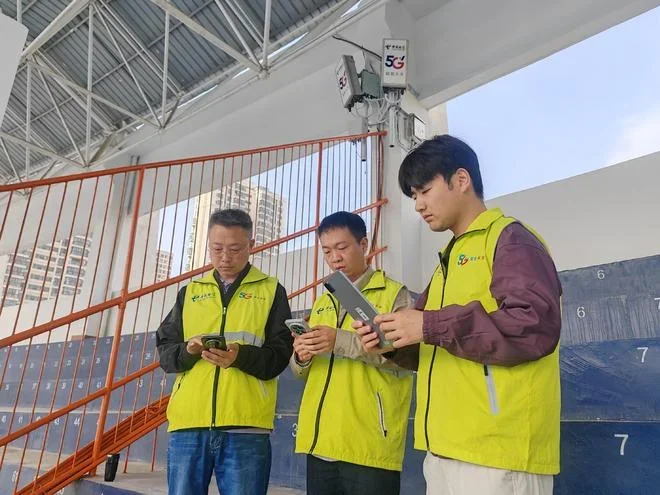
As enthusiasm for sports continues to surge across the nation, hosting large-scale sporting events has become a vital driver for consumption, cultural tourism, and regional economic growth. The 2026 Hubei Provincial City Football League, known as the Chu Chao League, kicked off at the Huangshi Olympic Sports Center with an on-site audience of 32,000 people. During the event, a massive spike in concurrent services—including video sharing, instant messaging, mobile payments, and live streaming—posed significant challenges such as high user density, heavy uplink traffic, complex interference environments, and demanding user experience requirements. Traditional networks were unable to support such high-quality viewing needs.
To tackle the difficulties of high-density and high-concurrency in large-scale cultural and sports events, the Hubei Telecom Cloud Network Optimization and Operations Center collaborated with local branches to deploy cutting-edge technologies, including 5G-A, AI computing, and intelligent data scheduling. By integrating digital technology into the entire process of event organization, spectator experience, and content dissemination, they established a comprehensive digital-intelligent communication support system. This system ensured precise coverage, intelligent scheduling, and stable user experience, thereby activating new productivity in the cultural and sports sector through the integration of digital and physical elements. The approach has created a replicable “Hubei Model” for large event support.
Based on the venue’s physical structure and the event’s business model, the network support team adhered to the principle of “digital infrastructure adapting to physical scenarios, data elements driving resource allocation, and intelligent algorithms ensuring user experience.” They constructed a full-dimensional digital-intelligent support system.
First, they precisely deployed digital infrastructure tailored to the physical environment. Considering the tiered, zoned seating and crowd distribution inside the venue, they adopted a “front-to-back coverage, upper-lower zone separation” strategy. High-performance AAUs, micro stations, and intelligent computing boards were installed inside the venue, while mobile communication vehicles were deployed outside to create a “high-density indoor, strong supplement outdoor” three-dimensional coverage. Multi-frequency and inter-frequency networking, combined with carrier aggregation technology, enhanced network capacity and interference resistance, adapting to the complex environment and high concurrency demands. AI computing capabilities were brought down to the base station side, enabling real-time local processing for service identification, resource scheduling, and interference optimization.
Second, data-driven precise scheduling ensured efficient resource allocation. Through intelligent computing, the system accurately identified and prioritized mainstream services: sensitive services such as QR code payments and voice/video calls were given priority with dedicated resources; large-traffic services like video uploads and short video browsing had their rates stabilized; and media and VIP users received deterministic identification-based guarantees. This ensured network resources were precisely directed to high-perception scenarios.
Third, digital-intelligent operations safeguarded the entire event. A closed-loop mechanism of “real-time monitoring—intelligent alarm—automatic response” was established, monitoring indicators such as user access volume, resource utilization, uplink/downlink speeds, and interference levels. Under high-load conditions, the system automatically triggered load balancing, power optimization, and coverage fine-tuning strategies. The support team was stationed in key areas, focusing on stands, VIP seating, media zones, and ticket-checking points to ensure excellent user perception throughout.
With the support of digital-physical integration, the Chu Chao League’s wireless network withstood the massive surge in users and traffic. High load did not reduce speed, high concurrency did not cause lag, and high density did not lead to disconnections. The network operated stably and reliably, significantly enhancing user experience. This fully validated the reliability and advanced nature of 5G-A and intelligent computing in large physical scenarios.
The practice of supporting the Chu Chao League has demonstrated that digital-physical integration is a key path to upgrading the cultural and sports industry and cultivating new productivity. Digital technology can only be transformed into tangible, measurable, and sustainable value when deeply integrated into real-world scenarios. Digital infrastructure must be tailored to physical settings, adapting to local conditions and implementing zonal strategies to fundamentally resolve the contradiction between capacity and interference. Data elements are the core driver for improving user experience, and based on AI and data, precise scheduling can upgrade from “best-effort” to “deterministic guarantee.” Digital-intelligent support is an essential requirement for large events, significantly improving reliability and reducing manual pressure. Furthermore, the experience from this event can be quickly replicated in high-density scenarios such as concerts, exhibitions, shopping malls, and transportation hubs, enabling large-scale empowerment of the physical economy.
